SofiNNa · NeuroTUM Hackathon 2026 · Innatera × Sofilab challenge · 5–9 Oct 2026 · team of 3
A neuromorphic chip that hears you sing
A 104-neuron spiking network on the Pulsar C1 chip that recognises which note someone is singing.
The challenge from Innatera and Sofilab: can a machine hear that someone is singing, know the note and follow along fast enough to sing with them? A sing-along partner has to work in any key and decide quickly, on the compute budget of a sensor chip.
My contribution
Board side and demo laptop, in a team of three.
I made the trained model run correctly on the chip and built the live demo around it.
Chip bring-up
Brought up the Pulsar C1 evaluation kit and built a host-to-Docker bridge so the chip SDK works from macOS.
Model on the chip
Found and fixed the bugs that kept the trained model from running correctly on the chip, including weight import, encoder scaling and recurrent-weight orientation.
Live demo
Built the bit-exact integer reference, the live chip loop, the note tracker, the synth and the live web page.
Testing without the board
Wrote 63 automated tests and a simulated chip, so the system can be checked without the hardware.
Side classifier
A separate speech / singing / background classifier on the board’s own microphone: 74.3 % per-window accuracy in a scripted test with one speaker in one room.
How it works
From voice to note in three stages.
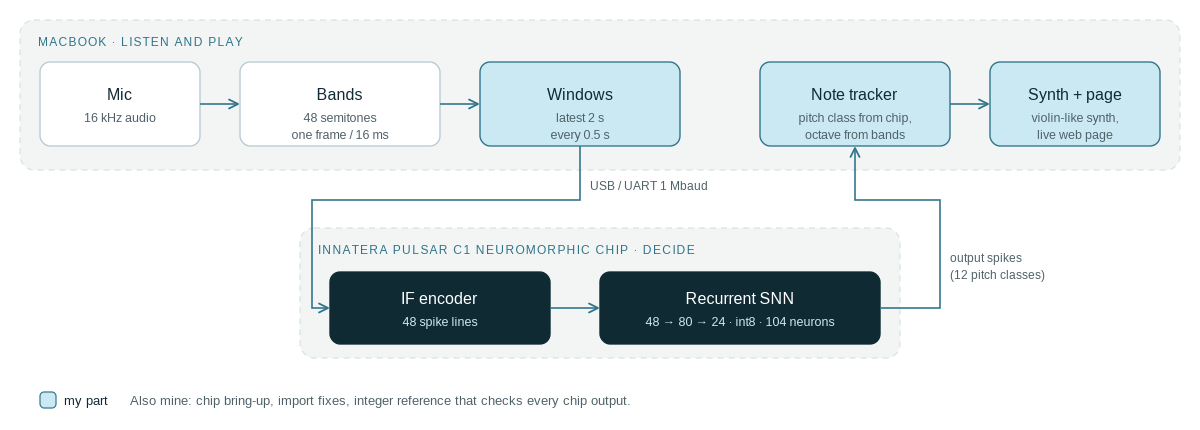
Audio is prepared on the laptop, the note is decided on the chip, and the laptop plays it back.
Laptop: listen
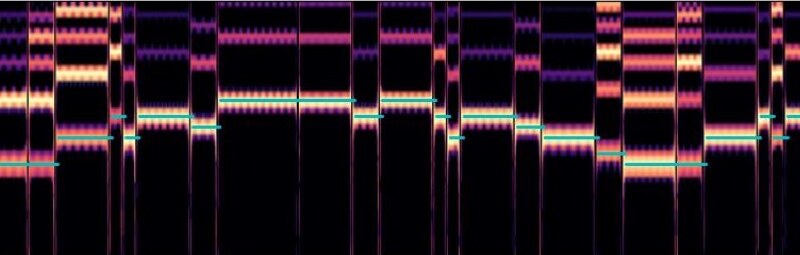
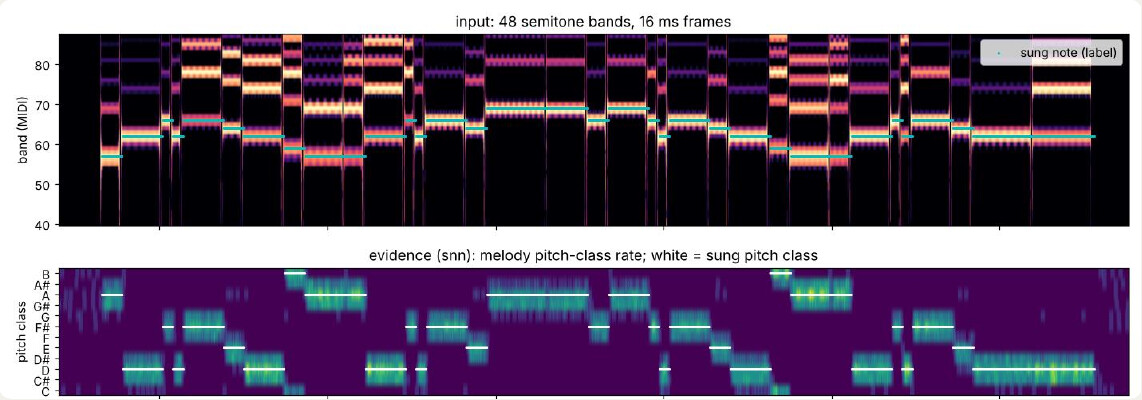
16 kHz audio becomes 48 semitone bands (82 Hz–1.25 kHz), one frame every 16 ms.
Chip: decide
An integrate-and-fire spike encoder feeds a recurrent spiking network (48 → 80 → 24, int8 weights, 104 neurons) that reports which of the 12 notes is sung.
Laptop: play
A note tracker picks the octave from the bands and a small violin-like synth plays the note.
Check
Every chip output can be compared spike by spike with the bit-exact integer reference on the laptop.
Results, with context
Bit-exact on the chip, about 7× chance on unseen singers.
The first number is a consistency check between chip and reference, not recognition accuracy.
1,451 / 1,451
test windows bit-exact
The chip’s output spikes match our integer reference exactly (91,343 spikes, none missing or extra).
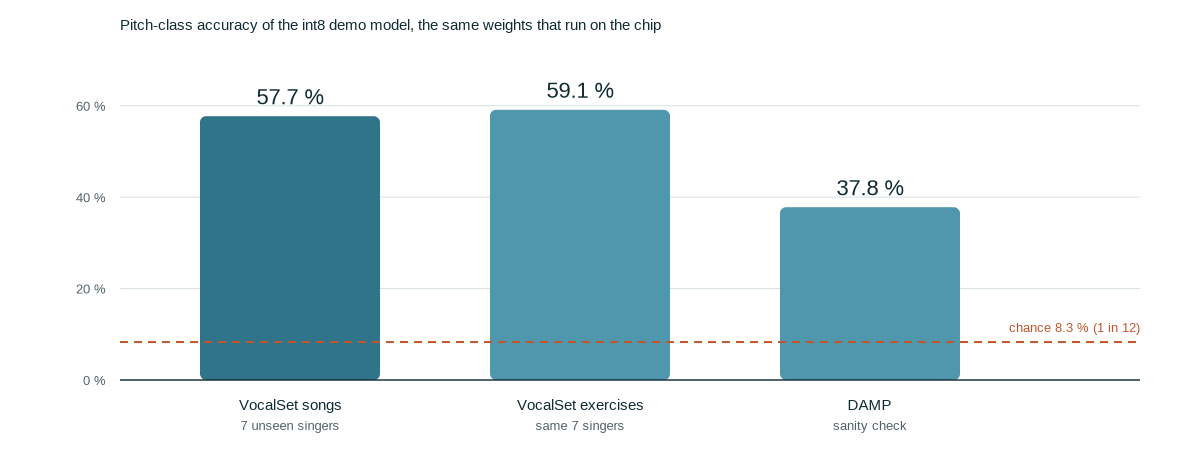
57.7 %
pitch-class accuracy
VocalSet songs from 7 singers left out of training; chance is 8.3 %. Offline test set; live singing was not scored.
23.2 %
of the chip’s RAM
The network uses 91,360 B of 384 KB.
A 20-minute live run: 2,396 of 2,396 windows identical to the reference, without a stop.
Reflection
The chip decides; the laptop still does the rest.
The spiking network runs on the chip, but the audio front-end, octave choice, tracker and synth run on the laptop.
Known limits
From voice to note takes about 1.25 s because of the 2-second window scheme. Power was not measured.
TeamJan Vitzthum (front-end, chord network, demo chain), Simon Appoltshauser (datasets, training, evaluation) and Yujie Yang (board side, live loop).
Full case study
NeuroTUM Hackathon · Innatera × Sofilab challenge · 5–9 Oct 2026 · team of 3
Making a trained spiking network run bit-exact on a neuromorphic chip
Five days, one Pulsar C1 evaluation kit, and a live sing-along demo at the end.
Why
The challenge from Innatera and Sofilab asked whether a machine can hear that someone is singing, know the note and follow fast enough to sing along. On a sensor chip that means a tiny network and a strict compute budget, so the question was less “what is the best pitch tracker” and more “what is the smallest network that still works on the real chip”.
Where each part runs
- MacBook: microphone at 16 kHz, a front-end that turns audio into 48 semitone bands (82 Hz–1.25 kHz) every 16 ms, and the window scheduling: every 0.5 s the latest 2-second window goes to the chip.
- Pulsar C1: an integrate-and-fire spike encoder (48 lines) and the recurrent spiking network, 48 → 80 → 24, int8 weights, 104 neurons, loaded into RAM.
- MacBook again: the output spikes are turned into a rate over 8 frames, a note tracker picks the octave from the bands, and a violin-like synth plays the note while a live page shows what the chip hears.
The four import bugs I found
At first the chip’s output did not match the trained model. Each of these looked like a training problem and was not:
- The weights were never used: they were written into live tensors, but the pipeline saved a separate parameter set, so every earlier check had run random weights.
- The spike encoder multiplied its input by 128 after quantisation; resetting that multiplier fixed the input scale.
- The recurrent weight matrix was not transposed: the two toolchains store it in opposite orders, and because it is square, a shape-based check let it through.
- The metric hid all of this: about 95 % of entries are silent in both spike trains, so “share of equal entries” scored 0.912 for unrelated outputs. Spike counts and spike-position F1 showed the truth.
Proving the chip computes the same network
I wrote an integer reference that applies the chip’s own neuron rules and compared every test window against the board. Result: 1,451 of 1,451 windows identical, 91,343 spikes with none missing or extra. The longest live run lasted 20 minutes: 2,396 of 2,396 windows identical, without a stop.
Where the time goes
- The network itself decides within tens of milliseconds.
- A 2-second window takes about 0.38 s for the round trip to the chip, mostly serial transfer at 1 Mbaud.
- Windows are sent every 0.5 s and the network is reset each time, so the demo uses a fixed 1.25 s playout delay; measured from audio to sound: 1.2547 s median.
- Sending one byte per band instead of floats, or computing the bands on the chip, would cut the transfer by a large factor.
A second result on the board’s own microphone
Separately, I put a speech / singing / background classifier (MFCC features into a 32 → 16 → 3 spiking network) on the board, running standalone on its own microphone once per second with the class on the display. In a scripted live test with one speaker in one room it reached 0.743 per-window accuracy.
What it is not
The audio front-end, the octave choice, the tracker and the synth run on the laptop. Accuracy on live singing was never scored, the chord accompaniment existed only as a laptop prototype, and power was not measured.